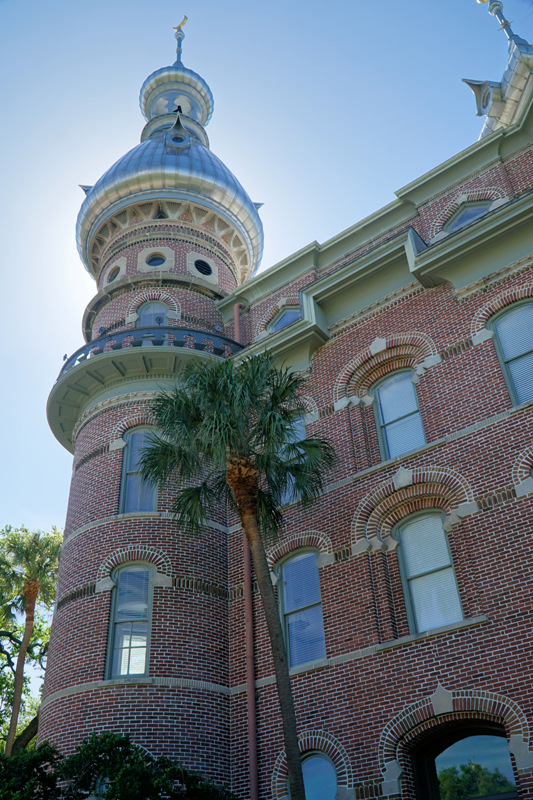
Tampa: Henry B Plant and Victorian Comfort

Henry B Plant was an entrepreneur. He had a growing transportation business and after the Civil War he bought up Southern railroads and incorporated them into his steamship lines. In order to entice the wealthy to ride his railroads Henry had built several lavish hotels. We visited his Tampa Bay Hotel which was completed in 1891. Now a museum, the hotel tantalized the rich with an opulent lifestyle  and cutting edge technology to provide leisure for the wealthy.

Today living in luxury is something we take for granted. Almost every vendor promises us that their product is the most deluxe, innovative and superior product. Panasonic brags, “Idea for Life”, “GE, We bring good things to life.” or GE’s latest, “Imagination at Work”. How about DuPont’s, “Better Living Through Chemistry”or “The 2018 Lincoln® Continental | Elegance, Performance, Luxury‎”.

Henry built his hotel as a modern destination. One of the most prominent features was the electric light. Pictured below is a female statue, hoisting aloft five bare light bulbs like a goddess of victory. The bare light bulbs have no shade because the intent was to show the magic of the technology.
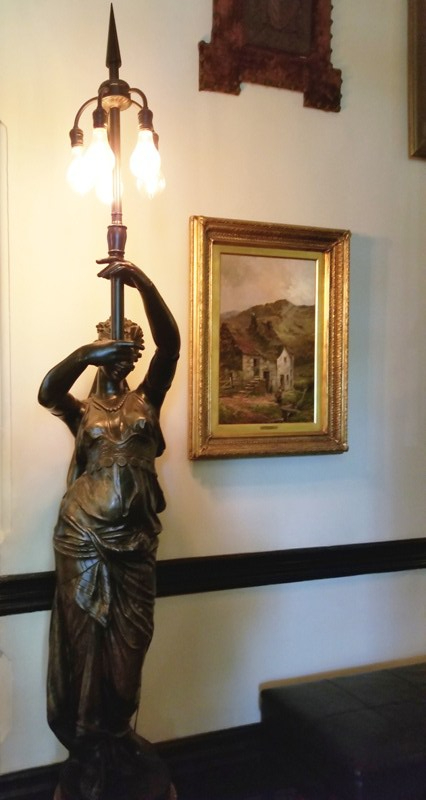
light statue 1 s

A statue to the modern light bulb.

The Moorish influence is gaudily expressed with its prominent multiple steel minarets, key hole windows and multiple balconies infused seamlessly with Victorian gingerbread. I asked one of the docents at the museum why Henry had chosen Moorish architecture? She explained that it would be regarded as exotic and eye catching. Well read guests were probably familiar with the contemporary English translations of the “1001 Arabian Nights.” Some cultured guests might have heard Rimsky Korsakov’s symphonic tone poem, “Scheherazade”.
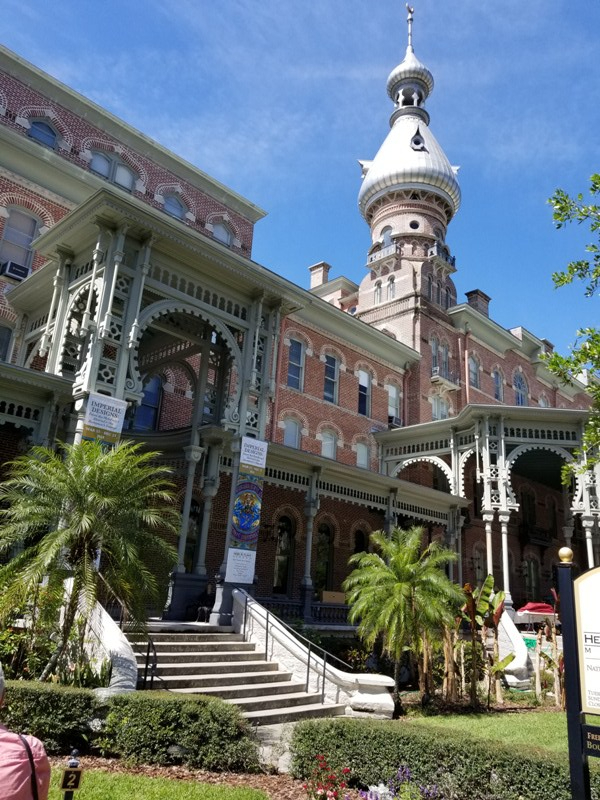
plant out1 s

Moorish towers and windows with Victorian gingerbread.

The guests were entertained with international artists such as Poland’s Paderewski on piano, Pavlova, the famous Russian ballerina or listen to exciting band music conducted by John Philip Sousa. The hotel provided everything: Hunting, sports, gourmet food, boating, etc.

This amazing palace was not a part of the metropolis of Tampa, because Tampa was a backwater village only accessible by Henry’s railroad or steamships.

Throughout the hotel are displayed ornate statuary, paintings, furniture and passageways.

The photo below show the music room. Notice the large horn to the left of the window. That device played back music recorded on cylindrical “records” using entirely acoustic means (no electricity). On the table is a photographic viewer that would render the specially prepared photos into “3D”.
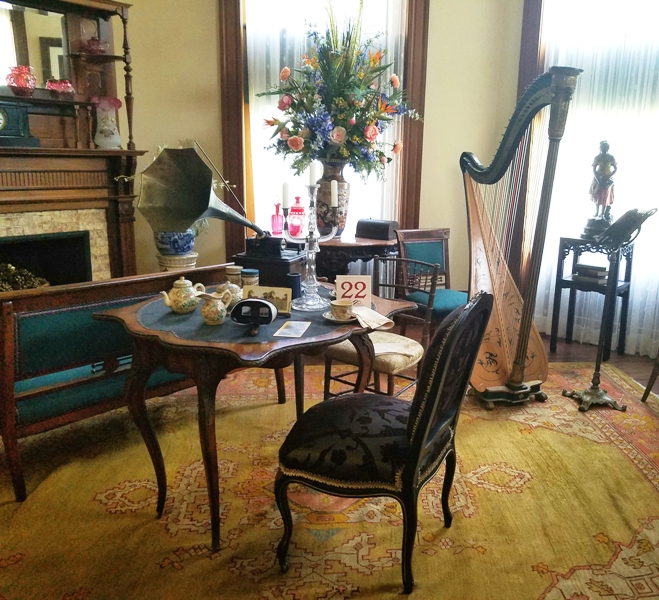
room2 s

Music room

We dined at the nearby Oxford Exchange, the 1890 era building, which caters to modern day guests seeking quiet and a chance to contemplate, even if the object of contemplation is often with one’s smartphone.

The museum is on the campus of the University of Tampa: Henry B Plant Museum, 401 West Kennedy Boulevard, Tampa, FL 33606 (plantmuseum.com)
 

The Depot

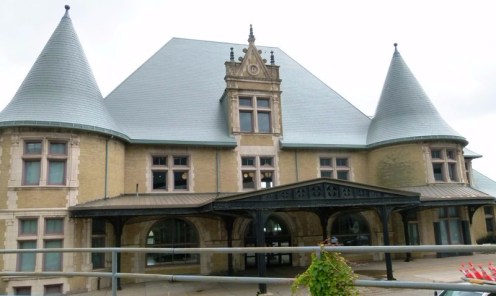
The old train depot, built in 1892 in Duluth, MN, is not just a preserved historical building. Inside are several separate museums that delve into fine Art, woodcraft as art and furniture, and a comprehensive display that honors and explains the craft and engineering of the train, particularly steam. depot smThe diversity of the exhibits are remarkable! Not only does the Depot house these fascinating museums, but is also home to the Duluth Playhouse and the Minnesota Ballet. I urge you to visit this place.

The Duluth Art Institute features various artists. While we were there, they highlighted the artist Jonathan Thunder. He is a painter and digital media artist currently residing in Duluth. He has attended the Institute of American Indian Arts in Santa Fe and received a Bachelor’s Degree in Visual Effects and Motion Graphics from the Art Institutes International Minnesota. To quote from his site, “Jonathan’s paintings explore personal themes of identity, life transitions, internal conflict, and self-transformation. He depicts expressive characters whose emotions and thoughts manifest viscerally in their physical form. The bodies of his subjects often appear fragmented, disfigured, animalistic, or partially obscured. They portray the prison of old patterns and the desire to fluidly overcome them. His art acts as the scrapbook recording an evolving identity. Through his subjects, Jonathan can exaggerate the villains and heroes that make up his self-image. A strong theme focuses on the ability of the self to break away from ‘what it has been programmed to do.’ His work questions the cost of conformity, examines moral responsibility ….” I found his art both riveting and disturbing.

The art of woodworking takes the form of furniture and folk like carvings. The furniture of Herman Melheim (April 24, 1891- February 23, 1990) is exceedingly ornate, looking like it was done at between 1880 and 1920. This is not surprising when you look at his life span except why did he look backwards toward his birth for aesthetic inspiration? The most startling piece is the television stand. The television is circa 1970 encased in this ornate cabinet. The plastic of the TV is so remote from the beautiful wood. It would sort of be like driving a Model T Ford with an advanced navigation screen that was integral to the design of the car.  I have considerable admiration for his craft since woodworking is one of the skills I have had to develop for maintaining our wooden vessels. Gratefully, I do not need to have Herman’s skill for the work that I do.

Unfortunately, the furniture is crowded into a small space, making the photography difficult.

The train portion of the museum mostly deals with steam engines. The steam technology advanced to the point that the last trains produced using steam were not lacking in speed or power. It was the maintenance cost that made steam technology obsolete. The museum not only displays the various engines, cars and equipment, but often accompanies the displays with videos showing the equipment being used.

The snow plow displayed is simple, yet massive. Videos showing the plow in use creates an explosive effect pushing feet of snow far beyond the track.

snow sm

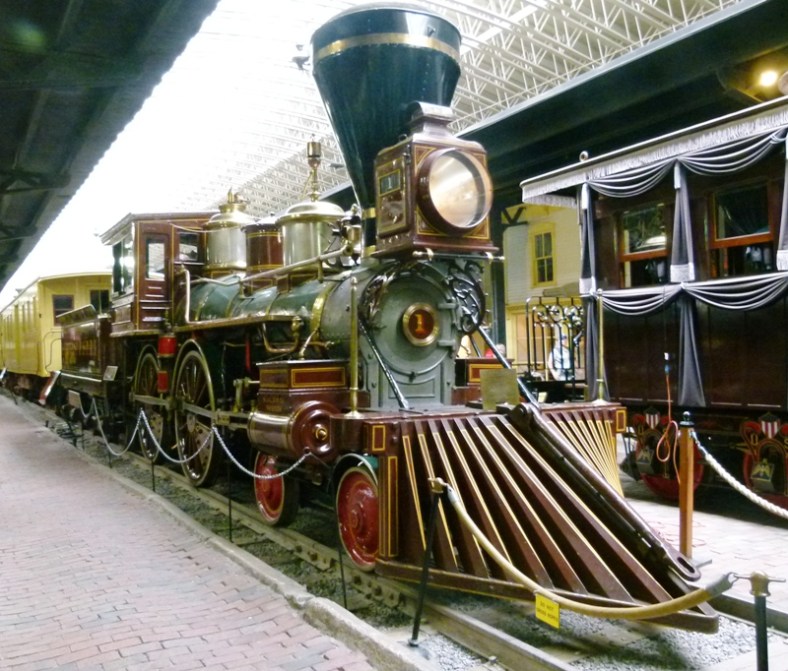
The engine shown below, the William Crooks, belonged to the St Paul and Pacific railroad.  The engine arrived by steamboat in Duluth on Sept 9, 1861. To put this in perspective, this is the same year that hostilities broke out and plunged the United States into civil war. This is one of the few remaining locomotives from that time. Personally, I think this train is beautiful. The melding of the many metals is eye pleasing both as sculpture and as an engineering achievement. Kudos to the museum for keeping up these engines in such great condition.

civil sm

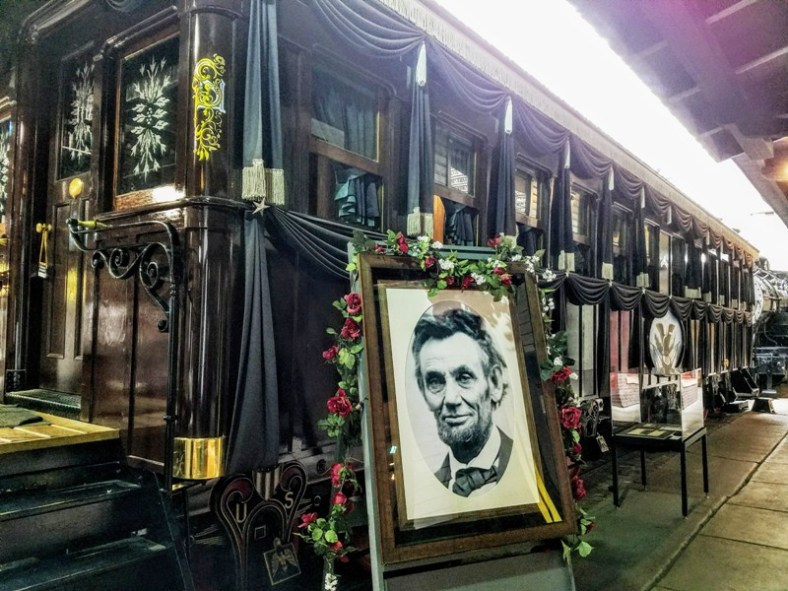
Not only did they have this engine from the civil war, but they also had President Lincoln’s funeral car, or so I thought. When I went to research the details, I found out from the History Channel site, that that car burned in a prairie fire in Minneapolis in 1911. Further investigation revealed that the car on display is a fairly accurate reproduction. The Depot gives the following information. “Using photographs, written descriptions, pieces of charred metal, and a single wood frame window removed from the car before the blaze, an exact, full-sized replica of ‘The Lincoln Funeral Car’ was constructed. This colossal effort took over five years and was completed in time for the 2015 Sesquicentennial of the original train ride from Washington to Springfield.”  Lincoln sm

Duluth was a great stop, not only for the Depot, but the Lake Superior Maritime Visitor Center and the lift bridge. Duluth is also a major shipping port. I wish we had planned more time to explore the area.

Mitchell, South Dakota: Corn Palace, Andrew Carnegie Library

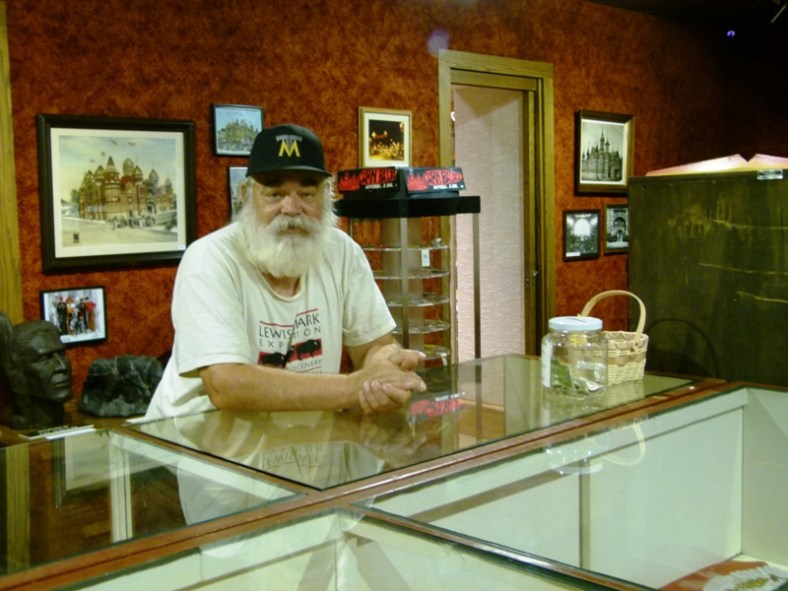
Mitchell, SD became the focus for this blog because of the enthusiasm and kindness of Ron Fuchs. I walked into the Andrew Carnegie Library and looked around. I saw darkened rooms, but to my left was Ron at his computer. I was ready to walk out when Ron pulled away from his desk and offered to give me a tour of the library and told me some of the history of the town.  A larger library has recently been been built and this building is now home to Mitchell Area Historical Society (MAHS) and the Mitchell Area Genealogical Society (MAGS) and the building is now officially called the Carnegie Resource Center.

ron fuchs sm

Ron Fuchs knows Mitchell, SD. Not just the statistics, but the human stories that makes life truly interesting. Thank you Ron.

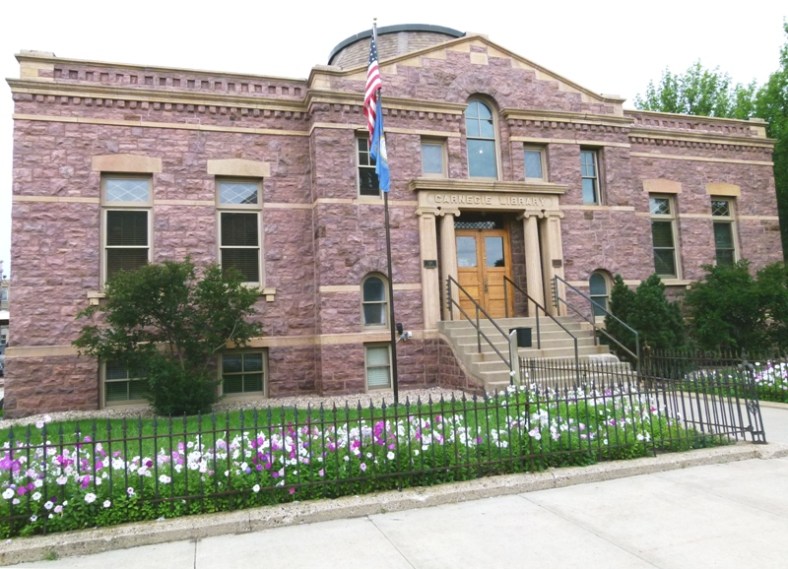
Alexander Mitchell (1817-1887) and Andrew Carnegie (1835-1919) may have known each other. They were both born in Scotland and both extremely wealthy. Andrew contributed the funding for the Library in Mitchell in 1903. He funded the construction of  2,509 libraries.


carnegie library sm

A gem of  a building. So glad I stopped. Note the Ionic columns framing the double doors.

Alexander Mitchell was president of the Chicago, Milwaukee, and St. Paul Railroad (Milwaukee Rd). Mitchell, SD was originally named Firesteel but was changed to Mitchell in anticipation of the completion of the Chicago, Milwaukee, and St. Paul Railroad in 1880. His grandson was the famous Billy Mitchell, the pioneering aviator who was able to convince the military of the growing importance of air power during World War II.

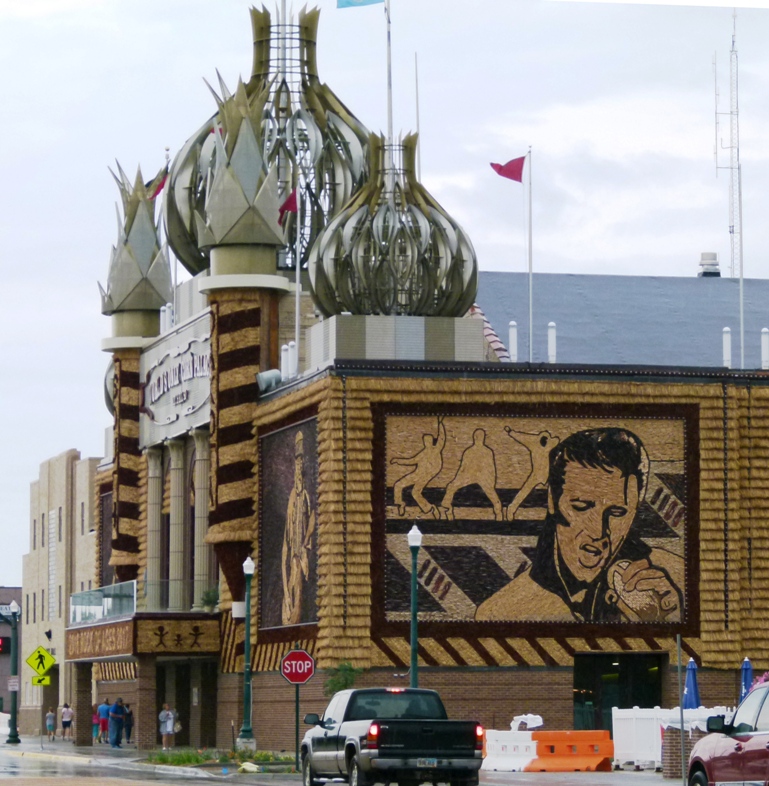
Mitchell has the last remaining Corn Palace (there were 34 palaces throughout the state). What is a Corn Palace? The building acts as a civic center, indoor sports arena and theater. The walls of this building have panels depicting history, famous visiting artists and other scenes from life in this western agricultural town. The panels look like they are made out of tile, which may explain the Moorish influence of towers and minarets.  The tiles are actually corn husks of various colors which are changed every year. From 1948 to 1971, the artist Oscar Howe (1915-1983) designed the panels.


This year is an exception, for the drought was so devastating that it will be a major financial effort to renew the panels after two years. This is ironic, for the intention of a corn palace is to show the world and potential farmers that this is a great and profitable place to grow corn!

cow palace profile sm

Elvis in corn husks!

Oscar Howe also painted the dome of the Carnegie Library.  His art is bold and intriguing in its design. The Library rotunda displays many of his art works.

We also visited the McGovern Legacy Museum at the Dakota Wesleyan University. George McGovern was a prominent teacher, statesman, humanitarian and Senator. The information is well presented.  For more information: Click here!


Oregon Coast Historical Railway

Traveling the Oregon coast means driving US Route 101. There are side roads, but no alternate coastal passage. We take traveling by car (OK, truck, RV, etc) for granted. But this highway was not completed until 1926! Before the highway and railroad, travel and commerce was by boat or by foot. Local traffic by horse and wagon would often rely on traveling using the beach, but only at low tide, weather providing. That meant that the small fishing villages along the coast were relatively isolated.

It was a big deal when the railroads opened up commerce and transportation.  As Ellen and I travel along US 101 it is quite obvious that the highway paralleled the railroad.

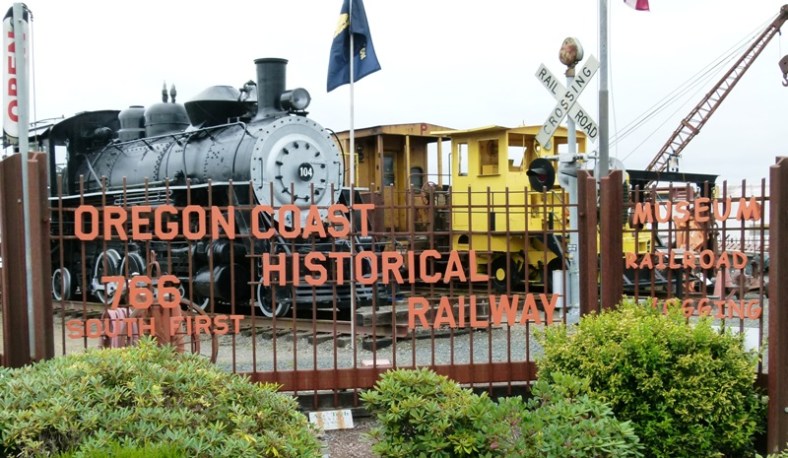
While traveling North from Port Orford, we passed through the town of Coos Bay and stopped for lunch, pulling to the curb next to the Oregon Coast Historical Railway. That is a nice benefit of RVing. Hungry? Just park and eat. This was an unplanned stop, but as you can see below, well worth our time.

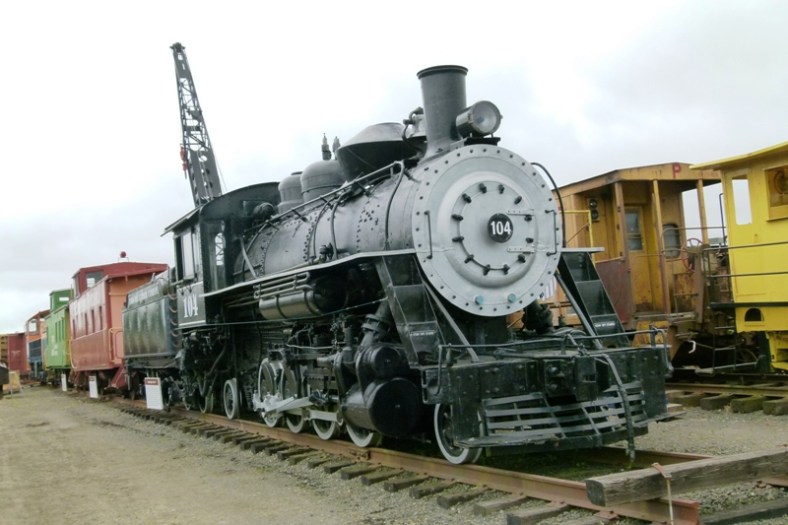
The engine and its coal tender, pictured above, was used from 1922 and 1960. It was purchased by the Coos Bay Lumber Company from the Baldwin Locomotive Works in Philadelphia, PA. In 1956 it was sold to Georgia Pacific and moved to Toledo, OR.

coos rail (2)sm

Here is a front end shot of this magnificent engine! 

Steam engines were not replaced because of a lack of speed or hauling power. They were replaced by diesel/electric engines because of the high cost of maintenance involved with steam.

I also saw two strange looking vessels. At first I thought they were ice breakers for inland pounds. Look carefully and you can see that one of them was powered by an outboard and the fuel tank was stored above the engine. I sent an email to the museum asking for an explanation. I received this information from Tom Baake:

“The boats you’re referring to are called Nelson Pond Broncs, and they were used to corral logs floating in storage ponds adjacent to sawmills. The logs are often stored in water to slow down the aging process, or “checking,” that can occur if logs are stacked in the sun. It’s also a way to minimize fire danger in sawmills. The boats were actually “invented” in Coos Bay by a man named Nelson. The one you photographed is an authentic Nelson pond bronc, and the other was based on the same design but fabricated independently by the Roseburg Lumber Co. sawmill shop. Both have those distinctive “dogs” of iron spikes on the front, the better to corral and push around logs. The engines are center mounted so the little boats can turn on a dime as they jockey the logs around, hence the nickname “bronc,” because they sort of go every which-way when they’re in action. They still use pond broncs in sawmills around the Pacific Northwest; the Roseburg mill in Coquille has one in their log storage pond and it’s really fun to watch it work — lots of froth and splashing.”

If you are anywhere near Coos Bay, on the rugged Oregon coast, visit the museum.  Oregon Coast Historical Railway and display area, 766 S. First St. (US 101 Northbound), Coos Bay. They are open 9 a.m. to 3 p.m. Wednesdays and Saturdays year round. Free admission. Many thanks to Tom Baake for allowing us to post this blog.

coos rail (4)sm

“A Dream Come True”

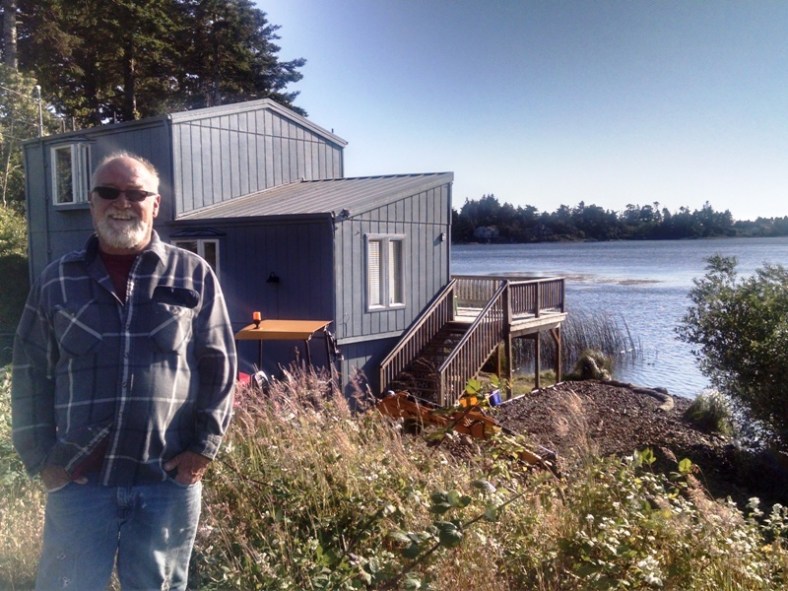
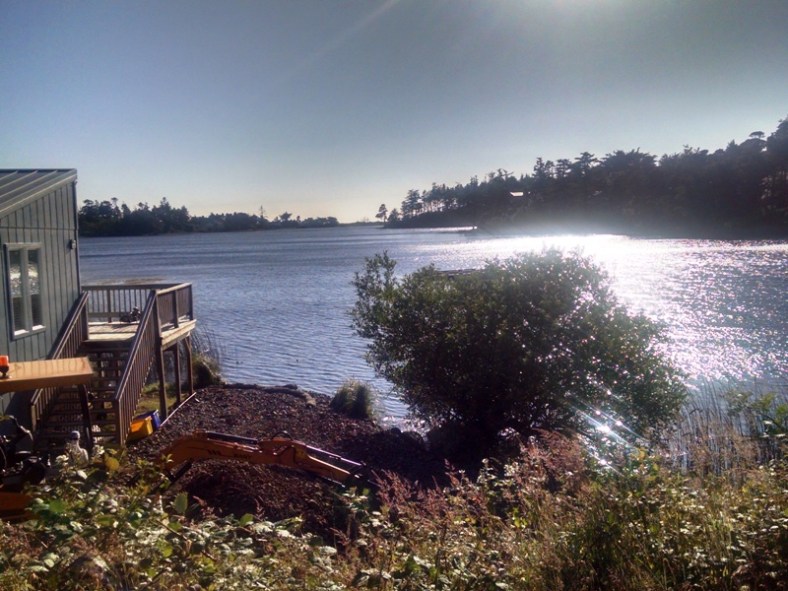
We are in Port Orford, OR. I will have more photos of this unique place later. We had just arrived and I felt compelled to take a quick walk. I shot this photo not more than 2 blocks from our campground. Notice the home to the left.

garrison lake sm

Standing by his house is Byron. He greets me and I return his greeting with a comment about how beautiful this spot is. He surprises me with, “This is a dream come true.” That comment from a perfect stranger is out of the ordinary and so I reply, “Why?” Byron told me he had just retired and had always wanted a place by the water. This is was perfect: A house overlooking Garrison Lake which was a stone’s throw from the ocean. Byron is originally from Texas.

byron sm

Byron, “like the poet”

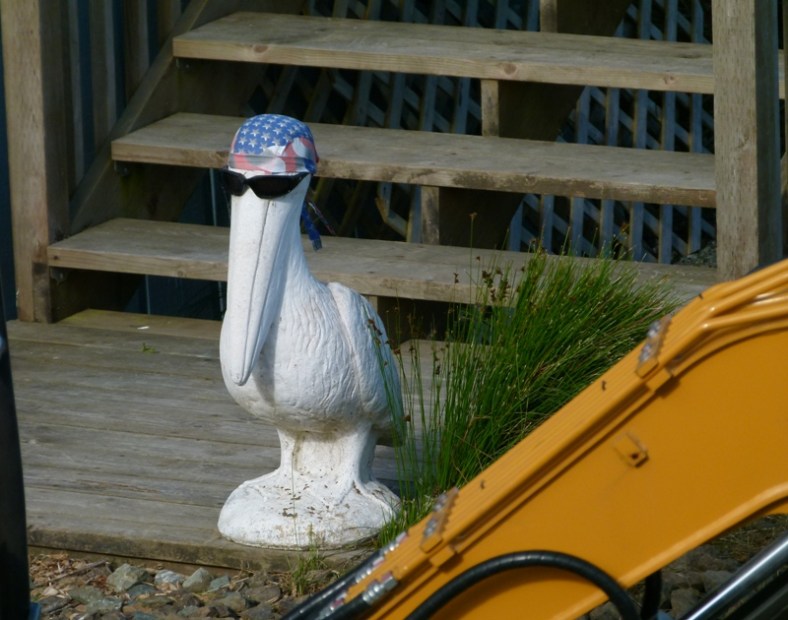
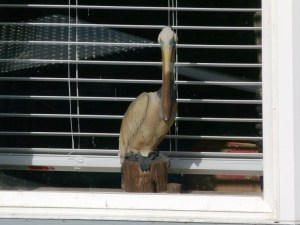
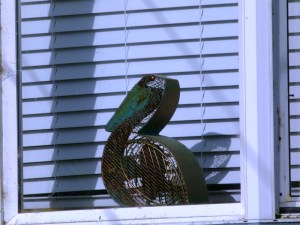
In Texas he lived on the Pelican Ranch. He brought his pelican friends with him to Port Orford.

byron (2)sm

Guard Pelican!

byron (7)sm

Window Pelican

byron (6)sm

Pelican art

Byron tells me that the lake does not have access to the sea, even though it is separated by a few yards of earth. During the night he is lulled to sleep by the pounding of the unseen surf.

More stories to come, but I just wanted to get this one told.

Kite Boarding at Pismo Beach, CA

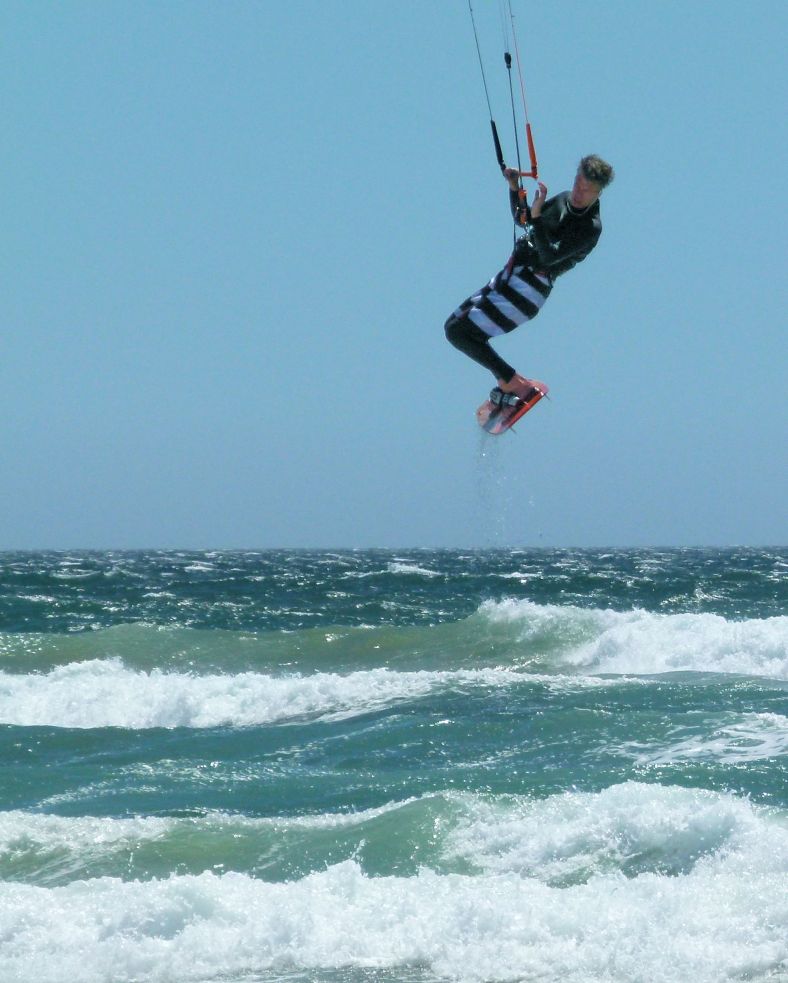
On the last day of May we were staying at Pismo Sands Campground, at Pismo Beach, CA. This part of California is ideal for kite boarding, especially during the Spring. Ellen and I wandered down to the town beach each having our own cameras. The strong, cold sea breeze for this particular day was blowing 25-30 knots gusting to 35. Ellen had only brought a light jacket forcing her to retreat inland. The wind blew the fine, almost powdery sand to such an extent that my first shots were my best. After the first 10 minutes my glasses became so covered with salt and sand that I had to quit because I could not see through the camera!

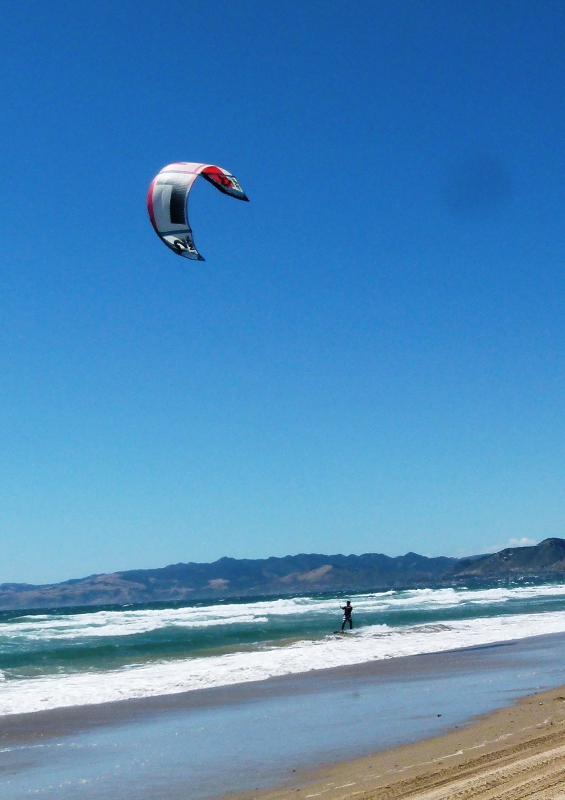
I will show you some photos of the kites and boards but the video  only shows the kite boarder (please click on this Link.). The reason being is that the kite is so high in the air that if I showed both, I would be so far from my subject that there would be no details. To illustrate the problem, look at this photo.

Kite and boarder sm

Kite boarder and kite. Note the lack of detail. Also note the robust sea conditions.

It was extremely difficult to hold the camera still, particularly as I zoom closer to the kite boarder.

The following photos show the kite boarder balancing his weight against the lift of his kite.

brian

The kite boarder is clearly in control and is enjoying every moment of this ride!

brian2

Creating his own spray.

brian3

Airborne! You can see water spilling from his board.


Ken and Gigi

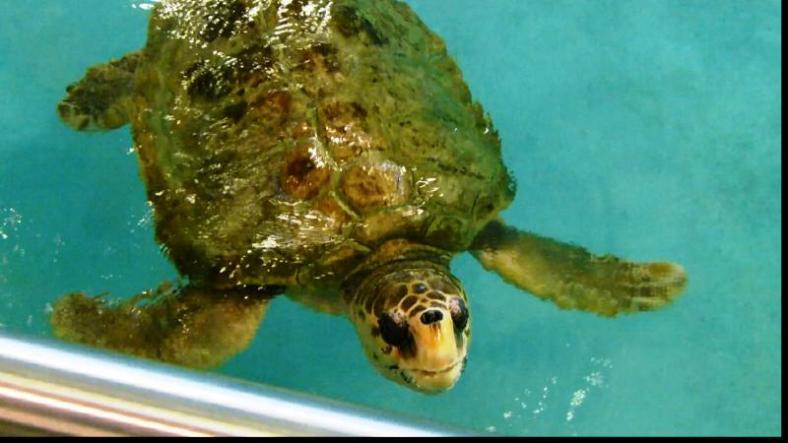
No, I do not have a young something! Gigi is a Loggerhead sea turtle. We met yesterday by accident when I decided to go bicycling on Navarre Beach and came across her home at the Navarre Beach Sea Turtle Conservation Center. It’s a small building that was originally the visitor center for Navarre Beach Marine Park.  Gigi has her own pool.

Gigi1_FF

Gigi coming up for a breath of air.

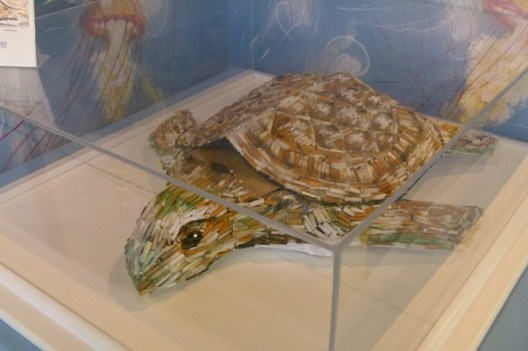
Cathy, one of her curators, enthusiastically explains her history and you understand that Gigi is special, and this organization is special for taking care of this animal in such an unusual setting. What is more unusual is that the Gigi is blind. Cathy explained how the turtle has adapted to this condition. She does respond to voices and is curious when her caretakers clean the pool. Being able to see Gigi and learn about her individual personality made me feel privileged. Watch the video! It is not just watching another fish. Observe her as she makes her way around the pool. Occasionally you will see her using her front flippers to feel the side of the pool. My feelings toward Gigi is not unusual. Others have remarked that they feel the same way. A local canvas maker, after seeing Gigi, has become inspired to make a cloth underwater environment in part of the pool to enrich Gigi’s tactile world. Gigi has been in captivity at Sea World for most of her life, some 30 years. She was  recently acquired by this conservation center. Having an inspiration can take strange forms. Here is a statue of Gigi made of what looks like cigarette butts.

turtle model

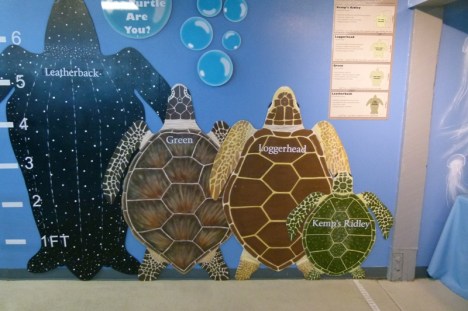
To give you some sense of scale, I have included a photo of several common sea turtles on a chart. Gigi is about 4 foot long.turtle size

The center has other exhibits as well. The exhibits appeal to the young as well as adults.  They have several small aquariums which house local fish including some sea horses.

Colors: Yellow Peril and Blue Angel

The  National Naval Aviation Museum (http://www.navalaviationmuseum.org/) is impressive! Using all criteria possible it is impressive. It is HUGE, well run, comprehensive and fun. I do not need to make this chapter a brochure. Go to the link and see all that the museum has to offer. There were some specific highlights that for me had special meaning.

naval museum sm

Entrance to the National Naval Aviation Museum

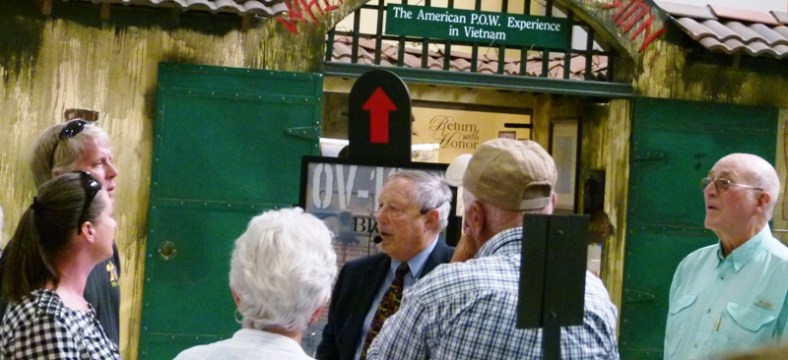
The docents are not just knowledgeable, they lived through some aspect of what they show and have very personal stories to tell. Our guide told us about some of his fellow  soldiers coping with conditions inside a Vietnamese POW camp. About tapping Morris code on the walls to communicate feelings when they were told they couldn’t talk.docent sm

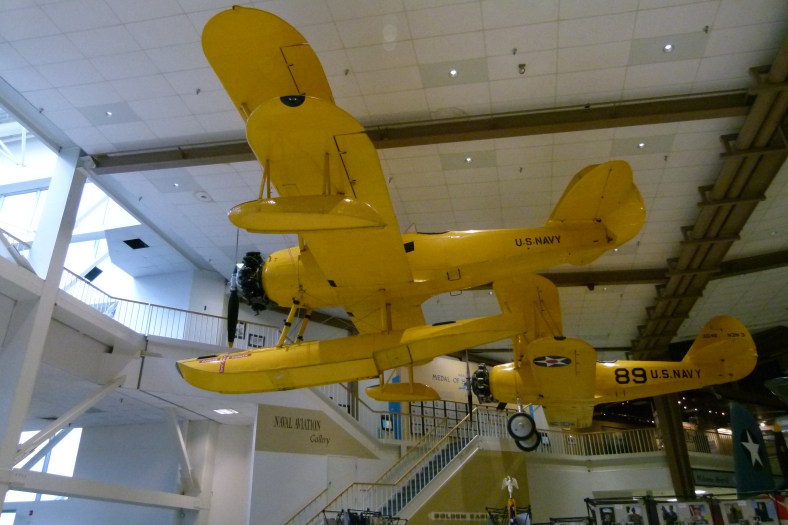
The history of aviation is told here, but I want to concentrate on just a few aspects of that history as it relates to me. In Annapolis, where I sail, I always point out where the Greenbury Point Naval Air Station was located (the FIRST naval air station in the USA), now the Navy Yard. Naval Midshipmen were required to learn how to fly the N3N, nicknamed the Yellow Peril. Named the Yellow Peril because it was (duh) yellow and peril because Midshipmen’s commission was in peril if they did not master flying the craft. They have both the sea plane its land equivalent. The difference is the landing gear. The pontoon for the Navy and standard strut and wheels for land.

Yellow sm

The N3N were first placed into service as training planes in June 1936 at NAS Pensacola, FL.

The planes were used at the Naval Academy, in Annapolis from 1946 (my birth year) to 1959.

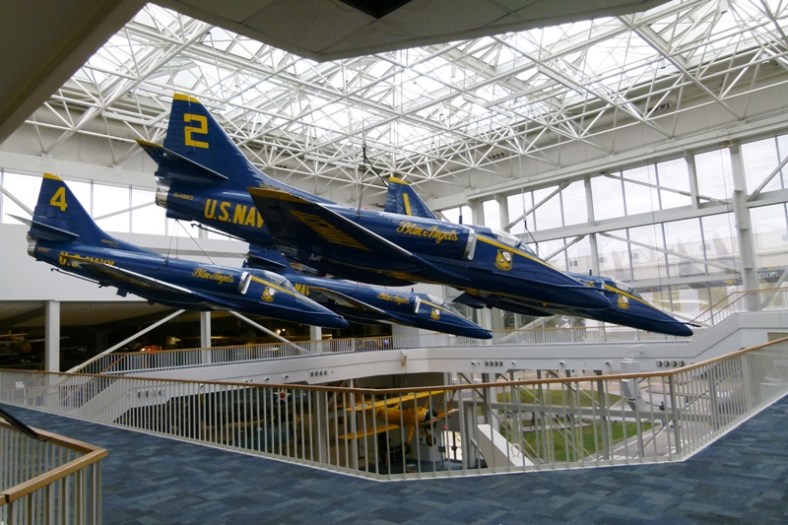
The other planes that are specific to my life are the Blue Angels F/A 18 shown below. Every May we have the thrill of seeing these planes during the graduation week at the Academy.

blue sm

I originally planned on cropping this photo, but it shows the drama of the planes as if they are in flight. My praise to the museum in how they used this space.  But wait, wait! Look below the middle “angel” and you can again see the “N3N” which represents a span of 59 years, from earliest production of the “N3N” to the last model of the F/A 18 production.
Kayaking on the Peace River

My first impression of the Peace River was wilderness. There is much to explore and much of it is unspoiled. Within the limited time of my travel what caught my attention was the contrast between undisturbed nature and development. I was able to come within a boat’s length of a heron stalking its prey. heron-bThere was an almost musical or dance like gate as he moved. Incidentally, I did not realize that I had captured the heron’s reflection until I began to edit the photo. Here is the video link of it in YouTube.
At first I saw the developed areas as awful and ugly. As I looked more carefully and gave it some thought, I realize that some people feel fortunate to be able to move so close to nature’s beauty. Some abuse the privilege, disturbing all around with complete disregard for the safety of others or what they do to the environment. The attitude, “I bought this expensive fast boat and by golly I deserve to use its power.”
As I rowed closer to the homes I noticed one home that had a boat shed with lifts over hanging the river. One of the boats is a steam launch. A more compact version of the “African Queen” for those of you who remember the movie with Humphrey Bogart. I have two photos. If you look carefully in the middle of the vessel you will see the boiler, valves and  guages. The sign out front says “NASA” in large caps and then in smaller lettering, “North American Steam Association”.

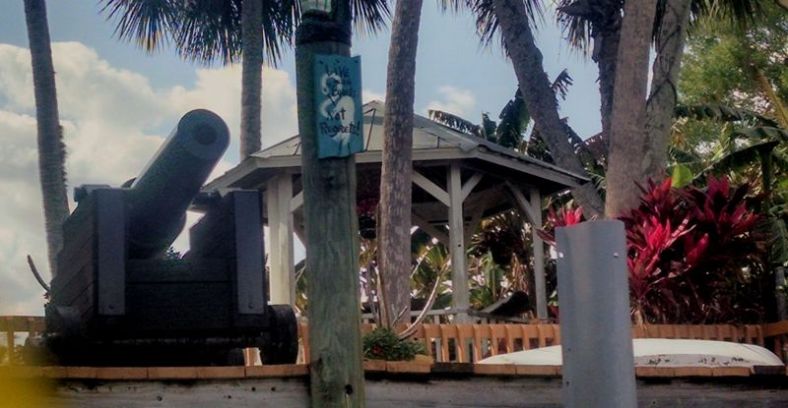
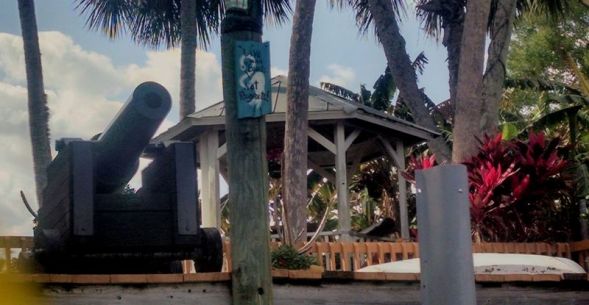
The owner has a vivid imagination and a sense of humor, for he has a  muzzle loaded ship’s cannon to protect his property. This would be the type of cannon used around 1815 or before.

cannon-b

Arrrgh, Stay clear matey!

Next to the steam launch were two friends, Maurice and John, who were painting John’s sea wall. I talked to them and inquired about the launch. Their neighbor Gene was brilliant and steam power was a more than casual interest.

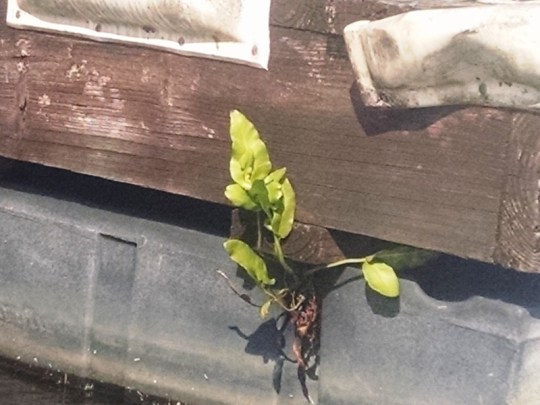
I explored the small harbor where the  Nav.a. gator restaurant and bar is located. As I left I noticed a small plant determined to survive in the small space it found among the timbers and steel.

plant-b

Nature persists and can adapt in the oddest of places.

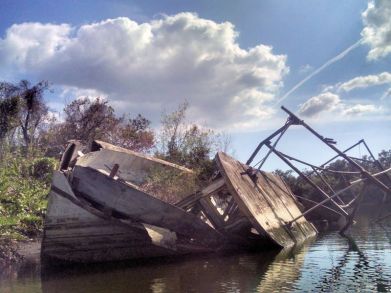
I entered Deep Creek, which is misnamed, thinking I had left “civilization” behind. However, I spotted a wreck on the shore.

wreck-best-b

Even the airplane contrail contributes to the aesthetic.

An old wooden fishing vessel lay rotting. The odd angles of wood, steel and foliage made for an interesting affect when captured by my camera.

COWS, Moosicians Outstanding in Their Field!

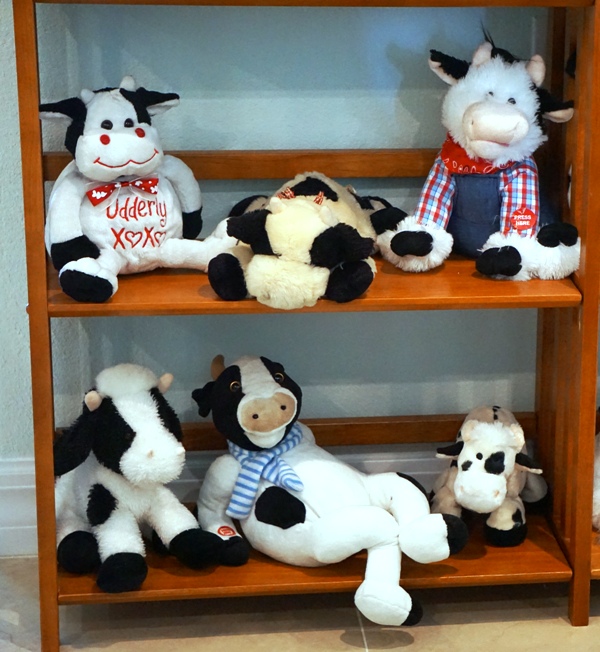
For those who know me, cows are a touchstone to humor and a collection of various cow-a-fanalia. For my friend, Cindy Partridge, cows are much more. At least as far as collection is concerned. She has more cows in more places than I can possibly imagine.

Cindy and I are high school friends who both played horn in the Platt High School Band in Meriden, Connecticut. We are 2 years apart, school wise. For both of us music has been a passion and playing music a means of support and comfort. We spent the first half of our lives teaching in Connecticut where we formed our own horn quartet and then both served in the same 76th Division Army Band (Army Reserve).

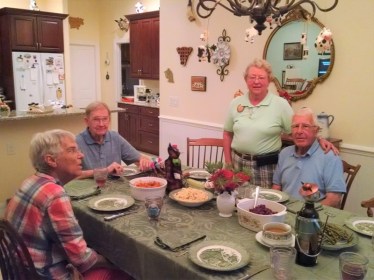
This February 1st, we had our sometimes annual reunion. For the first time, this reunion was in Port Charlotte, FL, at her home, instead of Annapolis.  She is one busy individual currently playing and/or conducting in 3 community bands and an orchestra. We also had dinner with her at her house where we met some of her musician friends, Norman and Joe and some mutual sailing friends, Eric and Julie Koch.

cindy-friends

From L to R: Ellen, Joe (clarinet, Cindy, Norm (trumpet). Look carefully. You should see at least 12 cows.


We had not seen the Koch’s for over 25 years!

I know I said this was post was about Cindy’s cows. I have saved the best for last. Grab a beverage and some popcorn and watch:

This slideshow requires JavaScript.

Moo, Moo, Moo!