Traveling the Oregon coast means driving US Route 101. There are side roads, but no alternate coastal passage. We take traveling by car (OK, truck, RV, etc) for granted. But this highway was not completed until 1926! Before the highway and railroad, travel and commerce was by boat or by foot. Local traffic by horse and wagon would often rely on traveling using the beach, but only at low tide, weather providing. That meant that the small fishing villages along the coast were relatively isolated.
It was a big deal when the railroads opened up commerce and transportation. As Ellen and I travel along US 101 it is quite obvious that the highway paralleled the railroad.
While traveling North from Port Orford, we passed through the town of Coos Bay and stopped for lunch, pulling to the curb next to the Oregon Coast Historical Railway. That is a nice benefit of RVing. Hungry? Just park and eat. This was an unplanned stop, but as you can see below, well worth our time.


The engine and its coal tender, pictured above, was used from 1922 and 1960. It was purchased by the Coos Bay Lumber Company from the Baldwin Locomotive Works in Philadelphia, PA. In 1956 it was sold to Georgia Pacific and moved to Toledo, OR.
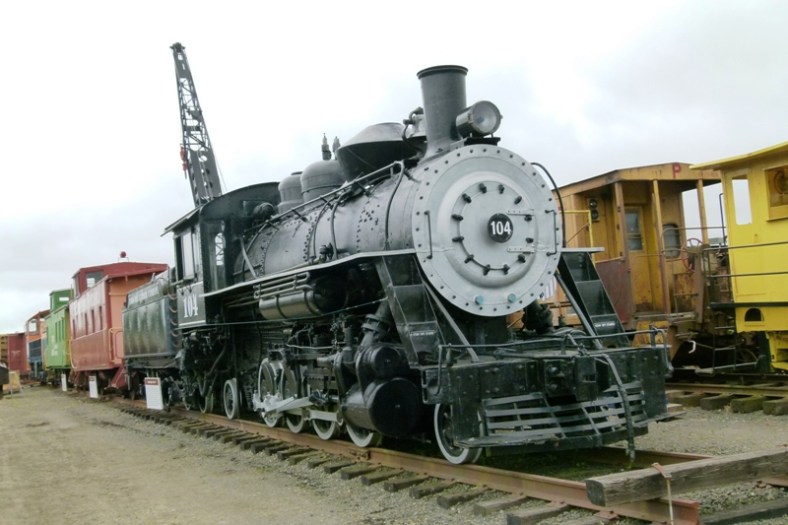
Here is a front end shot of this magnificent engine!
Steam engines were not replaced because of a lack of speed or hauling power. They were replaced by diesel/electric engines because of the high cost of maintenance involved with steam.


I also saw two strange looking vessels. At first I thought they were ice breakers for inland pounds. Look carefully and you can see that one of them was powered by an outboard and the fuel tank was stored above the engine. I sent an email to the museum asking for an explanation. I received this information from Tom Baake:
“The boats you’re referring to are called Nelson Pond Broncs, and they were used to corral logs floating in storage ponds adjacent to sawmills. The logs are often stored in water to slow down the aging process, or “checking,” that can occur if logs are stacked in the sun. It’s also a way to minimize fire danger in sawmills. The boats were actually “invented” in Coos Bay by a man named Nelson. The one you photographed is an authentic Nelson pond bronc, and the other was based on the same design but fabricated independently by the Roseburg Lumber Co. sawmill shop. Both have those distinctive “dogs” of iron spikes on the front, the better to corral and push around logs. The engines are center mounted so the little boats can turn on a dime as they jockey the logs around, hence the nickname “bronc,” because they sort of go every which-way when they’re in action. They still use pond broncs in sawmills around the Pacific Northwest; the Roseburg mill in Coquille has one in their log storage pond and it’s really fun to watch it work — lots of froth and splashing.”
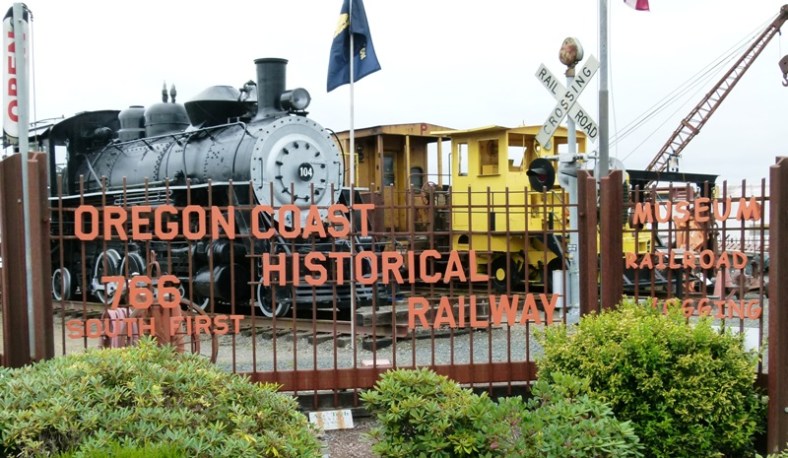
If you are anywhere near Coos Bay, on the rugged Oregon coast, visit the museum. Oregon Coast Historical Railway and display area, 766 S. First St. (US 101 Northbound), Coos Bay. They are open 9 a.m. to 3 p.m. Wednesdays and Saturdays year round. Free admission. Many thanks to Tom Baake for allowing us to post this blog.
 Ken and Ellen's Woodwind Prairie Schooner Travel Blog
One thought on “Oregon Coast Historical Railway”